Surf Tips and News
The Ultimate Guide to Catching Your First Wave Successfully Today exists because so many beginners hit the water full of excitement and then walk away frustrated after a single session. Here is what nobody tells you upfront: the “100-wave threshold” is the recognized point where surfing mechanics typically start to click for most newcomers, meaning one bad day in the water is not failure, it is just part of the process. Whether you are signing up for Surf Lessons Lahinch or gearing up on your own, this guide walks you through everything you need to stand on a board and ride your first wave with confidence.
Key Takeaways
| Question | Answer |
|---|---|
| What is the best board for catching your first wave? | A wide, stable beginner board like a mini-mal or longboard gives you the most surface area to paddle and balance on, making wave-catching far easier. |
| Do I need a wetsuit to surf in Ireland? | Absolutely. Atlantic water temperatures demand a quality 5/3mm or 4/3mm wetsuit to keep you comfortable and safe in the water. |
| How many lessons does it take to catch a wave? | Most beginners catch their first wave on their very first lesson with professional guidance from a structured beginner surf lesson program. |
| What is the best place in Ireland to learn to surf? | Lahinch on the west coast of Ireland is widely regarded as one of the best beginner surf spots, with consistent, gentle waves and world-class instruction. |
| What should a complete beginner focus on first? | Paddling technique and board positioning come before anything else. Get those right and the pop-up becomes significantly easier. |
| Is safety covered in beginner surf lessons? | Yes. Reputable schools always cover ocean safety and basic surf etiquette before anyone enters the water. |
| Can the Lahinch Live Cam help me learn to surf? | Yes. Watching live surf conditions on the Lahinch Live Cam helps you understand wave patterns, timing, and how the ocean behaves before you paddle out. |
Why Catching Your First Wave Successfully Today is More Achievable Than You Think
Most people believe surfing is a sport that takes years before you experience any real reward. That belief stops thousands of potential surfers before they even start.
The truth is that with the right board, the right conditions, and proper instruction, standing up and riding a wave on your first day is genuinely achievable for almost anyone. The ocean at Bens Surf Clinic in Lahinch is perfectly suited for beginners, with rolling whitewater waves that give you time to paddle, position, and pop up without the intensity of open-face surf.
The key is preparation. Beginners who walk into their first session knowing the basics of paddling and pop-up technique almost always catch more waves, faster. This guide gives you that preparation right now.
How Surf Lessons Lahinch Set You Up for Your First Wave
There is a measurable difference between teaching yourself to surf and learning under the guidance of a qualified instructor. Surf Lessons Lahinch at Bens Surf Clinic deliver a structured beginner program that covers safety, paddling mechanics, and getting to your feet within a single session.
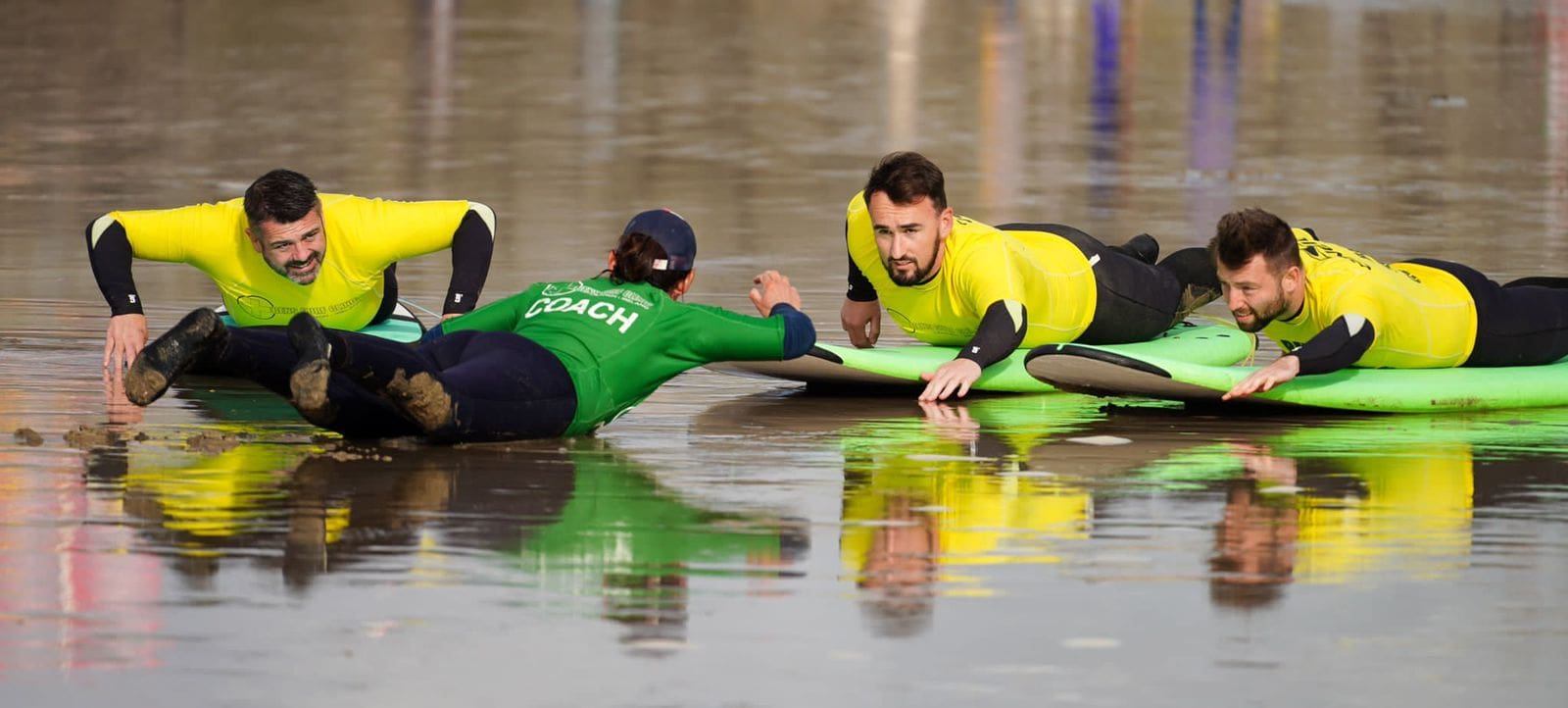
Instructors on the beach correct your technique in real time, which means you stop reinforcing bad habits that are nearly impossible to unlearn later. They also read the ocean for you, pointing you toward the right wave at the right moment so that your first ride is as clean as possible.
The beginner and improver surf lessons in Lahinch are designed to get you in the water quickly after covering safety basics, so you spend the majority of your session actually surfing rather than standing on the sand listening to theory.
“Beginner surf lessons get you in the water quickly after explaining safety and basic techniques. Develop and progress your surfing from your very first session.” – Bens Surf Clinic, Lahinch
If you are serious about catching your first wave successfully today, booking a lesson is the single most effective decision you can make.
Choosing the Right Surfboard: Your Ultimate Guide to First-Wave Success
Your board choice makes or breaks your first surf session. A board that is too small and you will spend every wave sinking and struggling. A board with proper volume and length gives you the stability to paddle, position, and stand up with far more control.
For absolute beginners, we recommend a mini-mal (mini malibu) or longboard-style board in the 7ft to 9ft range. These shapes provide generous surface area underfoot and enough foam volume to float you comfortably while you learn. The surf shop at Bens Surf Clinic Lahinch stocks a strong range of boards suited specifically to beginners.
Here is a quick comparison of beginner-friendly board types available at the Lahinch surf shop:
| Board | Best For | Price (EUR) |
|---|---|---|
| 8ft 4 Oxbow BIC Magnum | Stability, easy wave catching, all-round beginner use | €360 |
| CBC Softboard | Soft, forgiving surface ideal for first sessions | Contact for price |
| Surfworx Banshee Mini Mal | Lightweight, easy to maneuver for small surfers | Contact for price |
| Torq 9.0 Board | Maximum stability, excellent for heavier or taller learners | Contact for price |
The 8ft 4 Oxbow BIC Magnum in particular is a premium beginner board designed specifically for stability and easy wave catching, making it one of the best tools for anyone following this guide to catching your first wave successfully today.
Essential Gear Beyond the Board: Wetsuits That Keep You in the Water Longer
Ireland is not Hawaii. The Atlantic Ocean is cold, and if you are uncomfortable in the water, you will not last long enough to catch a single wave. A quality wetsuit is not optional, it is the piece of kit that determines whether you enjoy your session or cut it short after ten minutes.
For Irish conditions in 2026, a 5/3mm or 4/3mm wetsuit is the recommended thickness for most of the year. Here are the top options available through Bens Surf School Lahinch:
- Rip Curl Dawn Patrol 5/3 Chest Zip Mens Wetsuit – €217: Durable, proven protection with a chest zip for warmth and easy entry.
- Rip Curl Dawn Patrol 5/3 Womens Wetsuit – €217: High-performance features shaped specifically for women’s fit and flexibility.
- O’Neill Ninja 4/3 Chest Zip Womens Wetsuit – €270: High-end quality with exceptional durability for regular surf sessions.
- O’Neill Epic 5/4 Chest Zip Wetsuit: Hooded option for colder winter sessions when you need maximum warmth.
Ultimate Guide to Catching Your First Wave Successfully
A well-fitted wetsuit keeps your body temperature stable so your muscles stay loose and your focus stays on riding waves, not fighting the cold.
Step-by-Step: The Ultimate Guide to Catching Your First Wave Successfully Today
A visual guide outlining a simple 5-step process to catch your first wave. From paddling to popping up and riding safely.
Follow this proven sequence to give yourself the best possible chance of standing up and riding your first wave today:
- Paddle Out to the Right Spot
Position yourself in the whitewater zone (the broken, foamy section of the wave closest to shore). This is where the wave energy is most forgiving and easiest to catch for a complete beginner. - Lie Flat and Center Your Body on the Board
Your chest should be positioned just above the midpoint of the board. Too far forward and the nose dives; too far back and the tail drags. Find the sweet spot where the board sits flat and level in the water. - Time Your Paddle
Watch the wave approaching. When it is about one to two board lengths behind you, begin paddling hard with long, deep strokes. Match the speed of the wave before it reaches you. - Feel the Push and Commit
The moment the wave lifts the tail of your board and you feel forward momentum, give two or three final strong paddle strokes to fully commit to the wave. Hesitation at this stage is the number one reason beginners miss waves. - Pop Up in One Smooth Motion
Place both hands flat on the board beside your chest. Push up and bring both feet to the board simultaneously. Land with your feet shoulder-width apart, knees bent, arms out for balance. Your front foot should be roughly in the center of the board, your back foot over the fins.
Practice the pop-up on dry land before you enter the water. Instructors at Surf School Lahinch always include beach-based technique practice for exactly this reason, because muscle memory built on sand transfers directly into the ocean.
Reading Waves: Timing and Positioning That Make or Break Your Session
Catching waves is not just about physical technique. A large part of first-wave success comes from reading the ocean correctly before you even paddle for a wave.
Here are the core principles of wave reading for beginners:
- Wave type matters: White water (already broken) waves are ideal for beginners. They push rather than pull, making them far more manageable than unbroken, open-face waves.
- Watch the sets: Waves arrive in sets of three to eight, with lulls in between. Use the lull to paddle out and position yourself before the next set arrives.
- Position for the peak: The wave breaks steepest at its peak. As a beginner, position yourself just behind or at the side of the peak where the wave power is slightly less intense.
- Watch other surfers: Experienced surfers almost always position themselves where the best waves are breaking. Observe and learn from where they sit in the lineup.
- Use the Lahinch Live Cam: Before your session, check the Lahinch Live Cam online to assess wave size, direction, and how busy the lineup is. This preparation sets your expectations and helps you choose the best time of day to paddle out.
The Lahinch Live Cam is a genuinely useful tool that many visiting surfers overlook. Watching even ten minutes of live footage before you arrive at the beach gives you a mental picture of the conditions and makes you feel far more prepared when you hit the water.
Ocean Safety: What Every First-Time Surfer Must Know Before Paddling Out
No guide to catching your first wave successfully today would be complete without covering safety. The ocean is a powerful environment and treating it with respect is non-negotiable.
These are the safety essentials every beginner must understand before entering the water:
- Leash on at all times: Your board leash keeps your board attached to your ankle. Never surf without it. A runaway board is a danger to you and everyone around you.
- Know the rip currents: Rip currents are channels of water moving away from shore. If caught in one, do not fight it. Paddle parallel to the shore to escape the pull, then angle back in.
- Call for help when needed: Always surf near a lifeguarded beach when you are a beginner. Lahinch beach is patrolled during peak season, making it an ideal place to start.
- Never surf alone: Always have someone in or watching the water. Buddy up with another surfer or a friend on the beach.
- Protect your head: When falling, cover your head with your arms before surfacing. Boards, fins, and shallow sandbars are all potential hazards.
Every session at Surf School Lahinch begins with a thorough safety briefing. This is one of the most important reasons to take a structured lesson rather than heading out alone for your first time.
Using the Lahinch Live Cam to Plan Your Perfect First Session
One of the most underused tools available to beginner surfers in 2026 is live surf camera footage. The Lahinch Live Cam broadcasts real-time conditions at one of Ireland’s most beloved surf beaches and checking it before you head down to the water is a simple habit that makes a real difference.
Here is what to look for when watching the live cam before your session:
- Wave height: For beginners, waist-to-chest-high waves are ideal. Anything overhead is best left to more experienced surfers.
- Wave frequency: Waves arriving every 8 to 12 seconds give you enough time to paddle back out between rides.
- Crowd levels: A packed lineup is not beginner-friendly. Early mornings and weekday sessions tend to be quieter and more enjoyable for first-timers.
- Wind direction: Offshore winds (blowing from the land toward the sea) groom the waves into clean, rideable walls. Onshore wind (from sea to land) creates messy, choppy conditions that are harder to surf.
Combining live cam observation with Surf Lessons Lahinch creates the ideal setup for a successful first session. You arrive knowing what to expect and your instructor handles everything else.
Common Mistakes Beginners Make When Trying to Catch Their First Wave
Understanding what goes wrong is just as valuable as knowing what to do right. These are the most common errors that prevent beginners from successfully catching and riding their first wave:
- Paddling too late: Starting your paddle after the wave has already reached you means you never match its speed. Begin paddling earlier than you think you need to.
- Looking at the board during pop-up: Looking down shifts your weight forward and causes nose dives. Fix your gaze on the shore ahead of you as you stand up.
- Popping up in two stages: Rising to your knees first before standing is a very common error. The pop-up should be a single explosive movement, both feet landing simultaneously.
- Arms tucked in: Your arms are your primary balance tool. Keep them wide and slightly raised to stabilize your stance on the board.
- Choosing the wrong board: Trying to surf a shortboard on your first session is a recipe for frustration. Use a board with plenty of volume and length.
- Skipping the land practice: Beginners who skip dry-land pop-up drills consistently take longer to stand on a moving wave than those who practiced on the beach.
A good instructor from Surf School Lahinch will spot and correct these mistakes in real time, often shortcutting weeks of self-taught trial and error into a single productive session.
What to Expect When You Book Surf Lessons at Bens Surf Clinic Lahinch
Bens Surf Clinic is one of the most established surf schools on the west coast of Ireland, with a reputation built on producing confident, capable beginner surfers from their very first session.
Here is what a typical beginner lesson experience looks like when you book through Bens Surf Clinic:
- Safety and technique briefing on the beach: Before anyone enters the water, instructors walk through ocean safety, surf etiquette, and the basic mechanics of paddling and popping up.
- Dry-land pop-up drills: You practice the stand-up motion on the sand until it feels natural, building the muscle memory you need in the water.
- Supervised water session: Instructors guide you into the water, position you on waves, and provide real-time feedback as you attempt to stand up and ride.
- Progressive wave selection: You start in the gentlest whitewater and move to slightly larger waves as your confidence and technique improve.
- Debrief and next steps: At the end of the session, instructors outline what you did well and what to focus on in your next session.
All boards and wetsuits are provided as part of the lesson package, so you do not need to own any equipment to get started. If you do decide to invest in your own gear afterward, the Bens Surf Shop Lahinch stocks everything from beginner boards to quality wetsuits at competitive prices.
Progressing Beyond Your First Wave: Building a Lasting Surf Practice
Catching your first wave is a milestone, but it is also just the beginning. The progression curve in surfing is one of the most satisfying in any sport because there is always a new skill, a bigger wave, or a more technical maneuver to work toward.
Here is a simple progression roadmap for the first few months after your first session:
| Stage | Focus | Approx. Timeframe |
|---|---|---|
| Session 1-3 | Catching whitewater waves consistently, clean pop-up | First week |
| Session 4-8 | Steering and basic turns on whitewater, catching unbroken waves | Weeks 2-4 |
| Session 9-15 | Riding the open face, trimming along the wave, paddling out through breaking waves | Month 2 |
| Session 16+ | Bottom turns, cross-stepping on longer boards, reading wave sections | Month 3 and beyond |
Returning for improver lessons after your initial beginner sessions is one of the fastest ways to progress. The beginner and improver program at Bens Surf Clinic is designed to move with you as your skills develop, meaning you are always being challenged at the right level.
Conclusion
This Ultimate Guide to Catching Your First Wave Successfully Today has covered everything you need to go from complete beginner to standing on a surfboard and riding your first wave with real confidence. From choosing the right board and wetsuit to understanding paddling technique, pop-up mechanics, ocean reading, and safety, you now have a clear and practical roadmap for your first session.
The most important step is getting in the water. Whether you start by watching conditions on the Lahinch Live Cam, picking up a board from the Bens Surf Shop Lahinch, or booking directly into Surf Lessons Lahinch with a qualified instructor, the ocean is waiting and your first wave is closer than you think.
Visit Bens Surf Clinic today and take the first real step toward catching your first wave successfully. In 2026, there has never been a better time to start surfing in Ireland.
Frequently Asked Questions
Can a complete beginner catch a wave on their very first surf lesson?
Yes, most complete beginners catch and ride a wave during their first lesson when they receive proper instruction. Taking structured Surf Lessons Lahinch with qualified coaches dramatically increases your chances compared to trying to teach yourself.
What size surfboard should I use to catch my first wave successfully today?
For catching your first wave successfully today, choose a board that is at least 7 feet long with plenty of foam volume, such as a mini-mal or longboard. The extra surface area makes paddling and balancing far easier for beginners than shorter performance boards.
How do I use the Lahinch Live Cam to check if conditions are good for beginners?
Check the Lahinch Live Cam before your session and look for waist-to-chest-high waves, clean conditions with minimal wind chop, and a relatively uncrowded lineup. Calm, rolling waves are ideal for first-timers, while large or choppy surf is better left for experienced surfers.
Is Bens Surf Clinic good for first-time surfers?
Surf School Lahinch at Bens Surf Clinic is specifically structured for beginners, covering safety, technique, and supervised water time in every session. The school has a strong reputation for getting first-time surfers standing on a board and riding waves within a single lesson.
How long does it realistically take to learn to surf properly?
Most surfers agree that the mechanics of catching waves start to feel natural after reaching roughly 100 waves, which can happen across several sessions over a few weeks of consistent practice. With Surf Lessons Lahinch, progress is typically much faster than self-teaching because instructors correct technique errors in real time.
What is the best wetsuit thickness for surfing in Lahinch, Ireland in 2026?
For surfing in Lahinch during 2026, a 5/3mm wetsuit is the most versatile choice for year-round use, while a 4/3mm is suitable for summer months when water temperatures are at their warmest. Both the Rip Curl Dawn Patrol and O’Neill Ninja ranges available from Bens Surf Clinic are excellent options for Irish conditions.
Do I need my own gear to take surf lessons at Surf School Lahinch?
No, you do not need to own any equipment to take surf lessons at Surf School Lahinch. Boards and wetsuits are included as part of the lesson package, so you simply show up ready to surf. If you want to invest in your own kit afterward, the surf shop at Bens Surf Clinic stocks a full range of beginner-friendly boards and wetsuits.